Description
“A most learned study of Barbarossa, demonstrating astonishing familiarity with the operational details at all levels and offering a wealth of dazzling insights into the campaign. Fascinating reading, even if one does not agree with the author regarding the causes of Barbarossa’s failure.” – Azar Gat, Ezer Weizman Chair in National Security, Tel Aviv University; author of “War in Human Civilization” and “A History of Military Thought”
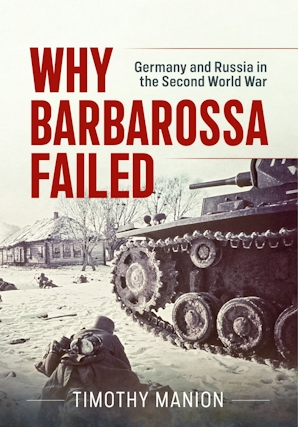
Why did Operation Barbarossa fail? For more than eight decades, historians have offered one dominant answer: Nazi Germany’s invasion of the Soviet Union was doomed from the outset. Vast distances, brutal weather, weak logistics and the overwhelming industrial power of the Red Army ensured that the Wehrmacht never had a realistic chance of success. But what if this familiar verdict is too comfortable — and too simplistic?
In Why Barbarossa Failed, Timothy Manion offers a bold, deeply researched re-examination of the most consequential campaign of the Second World War. Going far beyond the well-worn clichés of “General Winter” and German hubris, Manion places the story in a much longer arc: the evolution of military thought from the age of Napoleon through the catastrophe of 1914–18 and into the highly mechanized, manoeuvre-driven doctrines championed by both Germany and the Soviet Union in the interwar period.
Drawing upon a vast range of previously overlooked archival records, Manion demonstrates that both armies entered the war expecting a rapid, decisive campaign — a return to war between generals, not economies. Early German successes seemed to prove them right. But as Manion reveals, the Wehrmacht’s apparent mastery of mobile warfare concealed profound flaws in decision-making, command structure and operational logic. Meanwhile, the Red Army —though battered — adapted faster and more its opponent understood.
The result is a compelling challenge to the established consensus. Manion argues that Barbarossa did not collapse under the weight of numbers alone: German generalship and operational misjudgement played a far larger part than most accounts allow, while Soviet resilience and strategic learning proved decisive long before Stalingrad.
Rich with analytical clarity, packed with detailed campaign studies, and supported by an extensive set of newly published archival maps and figures, Why Barbarossa Failed is essential reading for anyone seeking to understand not only how the 1941 campaign unfolded — but why its outcome shaped the entire course of the war.
This is the story of two armies, two visions of modern warfare — and the decision points that sealed the fate of the Eastern Front.
Timothy Marion. Hard cover. English text. 376 pages. 6.7″ x 9.6″. 29 b/w maps. 16 colour maps. 5 figures. 10 tables.